
Artificial intelligence has moved far beyond simply answering questions.
For the past few years, most people have interacted with AI through chatbots. You type a question, the AI responds, and the conversation continues.
But a new generation of artificial intelligence is changing that model.
They are called AI agents.
Instead of only telling you how to perform a task, an AI agent can potentially plan the task, use tools, complete several steps, check its work and deliver the final result.
This shift from AI that answers to AI that acts is one of the most important technology developments of 2026.
OpenAI describes the growing shift toward agents as moving knowledge work away from short, isolated interactions toward delegated, longer-running tasks in which AI can use tools, interact with environments and work through multiple steps.
So what exactly is an AI agent, how does it work, and why are technology companies investing so heavily in them?
Let’s break it down.
What Is an AI Agent?
An AI agent is software powered by artificial intelligence that can understand a goal, determine what needs to be done and take actions toward completing that goal.
Microsoft defines an AI agent as a flexible software program that can use generative AI models to interpret information, reason through problems and decide what actions to take.
Think of it this way:
A normal chatbot might tell you:
“Here are the steps for creating a monthly sales report.”
An AI agent could potentially:
- Open your sales data.
- Analyze the figures.
- Calculate changes.
- Create charts.
- Write the report.
- Save the document.
- Send or prepare it for the appropriate person.
The important difference is action.
A chatbot mainly provides information.
An agent can combine intelligence with tools and workflows to accomplish a task.
Chatbots vs AI Agents
The easiest way to understand agents is to compare them with traditional AI chatbots.
Traditional AI chatbot
You ask:
“Help me plan a business trip.”
The chatbot may provide:
- Suggested destinations
- A packing list
- Hotel recommendations
- Travel tips
You still perform most of the actual work.
AI agent
An appropriately connected AI agent could potentially:
- Research flight options
- Compare hotels
- Check your calendar
- Create an itinerary
- Organize travel documents
- Update a spreadsheet
- Prepare reminders
The agent moves from being only an advisor toward becoming an executor.
That does not mean agents should operate without limits. Sensitive or high-impact actions still need appropriate permissions, safeguards and human supervision.
How Do AI Agents Work?
Although AI agents can appear complicated, their basic workflow can be understood through a few components.
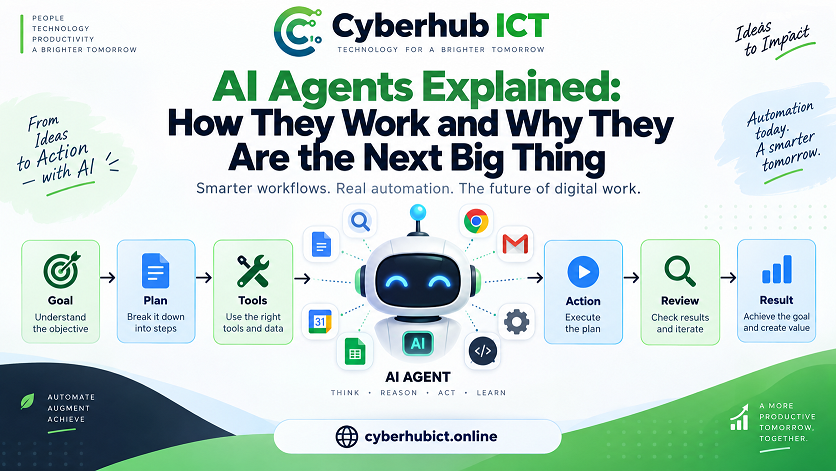
1. The User Gives the Agent a Goal
Everything starts with an objective.
For example:
“Research the five biggest cybersecurity threats affecting small businesses and prepare a report.”
The agent now has a destination.
But unlike a simple chatbot, it may need to determine how to reach that destination.
2. The AI Reasons About the Task
The agent may break the goal into smaller steps.
For example:
Step 1: Research recent cybersecurity threats.
Step 2: Compare information from reliable sources.
Step 3: Identify five important threats.
Step 4: Organize the information.
Step 5: Write the report.
Step 6: Review the final output.
This planning-and-execution cycle is a central part of agentic systems.
3. The Agent Uses Tools
This is where agents become particularly powerful.
An AI model by itself mostly processes information.
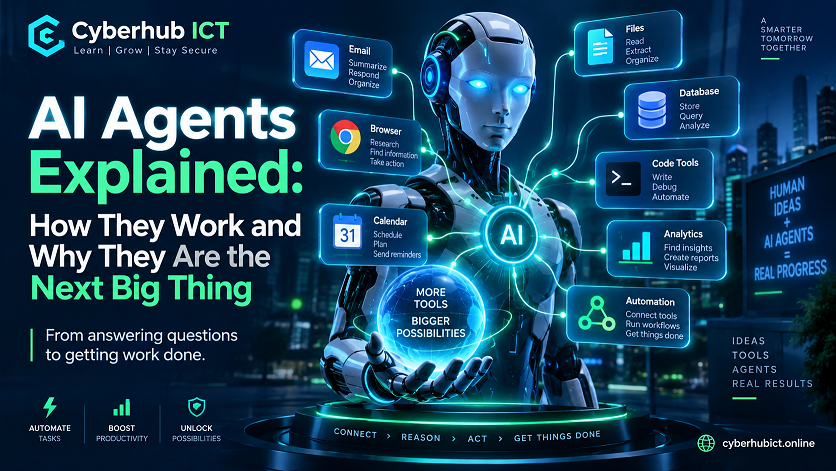
An agent can be connected to tools that allow it to interact with other systems.
Depending on its permissions, these tools might include:
- Web browsers
- Email systems
- Calendars
- Databases
- Spreadsheets
- File systems
- Payment systems
- Company applications
- Coding environments
- Customer-support platforms
- APIs
OpenAI’s Agents SDK, for example, supports agents that can work with files, run commands, edit code and perform longer multi-step tasks inside controlled environments.
The tools transform the AI from something that merely knows things into something that can potentially do things.
4. The Agent Observes the Result
After performing an action, the agent needs to determine what happened.
Suppose an agent searches a database.
It receives results.
It then asks, in effect:
Did this give me what I need?
If not, it might try another approach.
5. The Agent Adjusts Its Plan
An effective agent does not necessarily follow one fixed sequence.
It may change direction depending on what it discovers.
For example:
The first search produces outdated information.
The agent searches again.
A file is missing.
The agent checks another folder.
A piece of code fails.
The agent examines the error and attempts a correction.
This repeated process can be represented simply as:
Goal → Plan → Act → Observe → Adjust → Continue
That loop continues until the task is completed, stopped or handed back to a person.
A Simple Example of an AI Agent
Imagine you own an online store.
You tell an AI agent:
“Prepare my weekly sales performance report.”
The agent could potentially:
Step 1
Connect to the sales database.
Step 2
Retrieve the week’s transactions.
Step 3
Compare them with the previous week.
Step 4
Identify the best-selling products.
Step 5
Calculate total sales and profit.
Step 6
Generate charts.
Step 7
Write a summary explaining the major changes.
Step 8
Create the report.
Step 9
Place it in the designated company folder.
Instead of asking AI several separate questions, you assign it an outcome.
That is the basic idea behind agentic AI.
What Makes Up an AI Agent?
A useful agent normally combines several technologies.
1. AI Model
At the centre is usually a large language model or another capable AI model.
This provides the agent’s ability to interpret language, reason about information and generate responses.
2. Instructions
The agent needs rules describing its job.
For example:
“You are a customer-support agent responsible for answering customer questions about orders.”
Instructions can also define what the agent must not do.
3. Tools
Tools allow the agent to interact with external systems.
A customer-support agent might have access to:
- Customer records
- Order information
- Delivery status
- Refund systems
- Product databases
4. Memory and Context
Some agents need information from previous interactions or ongoing work.
Memory can help the agent understand what has already happened instead of restarting every task from the beginning.
Modern agent platforms are increasingly adding structured memory and context management for longer workflows. OpenAI’s updated Agents SDK, for example, includes configurable memory and infrastructure designed for long-running tasks.
5. Guardrails
Agents need restrictions.
For instance:
An agent may be allowed to prepare a bank transfer but not authorize it.
Another may draft an email but require a person to approve it before sending.
Guardrails are essential because an AI system capable of taking actions can cause more harm from a mistake than one that only generates text.
6. Human Oversight
Humans remain important.
Good agent systems should know when to:
- Ask for confirmation
- Request additional information
- Escalate a problem
- Stop an action
- Seek human approval
The future of AI agents is not necessarily about removing people.
In many situations, it is about changing which parts of the workflow humans perform directly.
What Is a Multi-Agent System?
One AI agent does not have to perform everything.
Several specialized agents can work together.
This is called a multi-agent system.
Imagine a digital marketing company.
One agent researches topics.
Another writes content.
Another performs SEO analysis.
Another creates a social-media plan.
Another checks the final work.
A coordinating agent manages the workflow.
This is similar to a human team where different people specialize in different jobs.
OpenAI’s current agent infrastructure supports coordinating subagents, while researchers are also studying the challenges created when increasing numbers of agents interact with one another.
Where Are AI Agents Being Used?
AI agents can potentially be applied across almost every industry.
Customer Service
An agent could:
- Answer common questions
- Check orders
- Troubleshoot problems
- Update customer records
- Escalate complex cases
Software Development
Coding agents can:
- Examine codebases
- Write code
- Debug errors
- Run tests
- Modify files
- Review software
- Help document projects
OpenAI reported in June 2026 that people were increasingly delegating longer and more complex work to coding agents rather than limiting AI use to short prompts.
Digital Marketing
Marketing agents could:
- Research competitors
- Find content ideas
- Analyze campaign data
- Draft advertising copy
- Prepare reports
- Organize social-media schedules
Education
Agents could help:
- Generate lesson materials
- Organize learning resources
- Provide tutoring
- Track learning progress
- Create practice exercises
Teachers would still need to check accuracy and determine how AI should be used appropriately.
Finance
Agents can assist with:
- Financial data analysis
- Invoice processing
- Expense categorization
- Report preparation
- Fraud monitoring
High-risk financial decisions should involve strict controls and human oversight.
Cybersecurity
Security agents can help monitor large amounts of security information and respond more rapidly to certain threats.
Microsoft noted in July 2026 that autonomous systems are increasingly able to reason, adapt and operate continuously, while attackers are also adopting AI to increase the speed and scale of cyberattacks.
This means AI agents can become both a cybersecurity tool and a cybersecurity risk.
Why Are AI Agents Becoming So Important in 2026?
The technology industry has spent years developing increasingly powerful AI models.
But intelligence alone is not enough.
The next challenge is enabling that intelligence to interact reliably with real work.
Microsoft has argued that organizations are moving beyond isolated chatbot experiences toward systems in which agents perform longer-running work across software development, customer support, finance, HR and operations.
OpenAI launched its Agents API in public beta on September 10, 2026, designed to let developers build and operate cloud agents capable of working with files, code, tools and longer-running tasks.
These developments show where the industry is heading.
AI is increasingly becoming less about:
“Ask me something.”
And more about:
“Give me something to accomplish.”
Why AI Agents Could Become the Next Big Thing
1. They Can Save Time
Consider an employee who spends two hours every Monday collecting information from five spreadsheets and creating a report.
An agent could potentially automate much of that process.
The employee could spend more time reviewing the conclusions and making decisions.
2. They Can Handle Repetitive Work
Many jobs contain repetitive digital tasks.
Examples include:
- Copying information
- Preparing reports
- Checking records
- Sorting emails
- Updating databases
- Scheduling activities
Agents are particularly attractive for workflows where the steps are repetitive but require some degree of interpretation.
3. They Can Work Across Multiple Applications
Traditional automation often follows rigid rules.
AI agents can combine reasoning with software tools.
An agent could potentially:
Read an email → find a document → analyze a spreadsheet → update a database → prepare a response.
This ability to connect multiple stages of work is one reason businesses are interested in agentic AI.
4. They Can Handle Longer Tasks
One major development in AI is the increasing ability to work on tasks that take many steps.
OpenAI reported that by May 2026, more than 70% of Codex users had assigned at least one task estimated to require a person more than one hour to complete.
The more reliably agents can handle longer tasks, the more useful they become.
5. Businesses Can Create Specialized Agents
Companies don’t necessarily need one general AI agent.
They can build agents for specific roles.
Examples include:
Sales Agent
Customer Support Agent
Cybersecurity Agent
Research Agent
HR Agent
Accounting Agent
Marketing Agent
Microsoft now offers ready-made, low-code and fully programmable options for building and deploying agents across its ecosystem.
Can Ordinary People Use AI Agents?
Yes.
AI agents are no longer something reserved only for large technology companies.
Many agent-building tools now provide:
- No-code interfaces
- Low-code builders
- Templates
- APIs
- Prebuilt integrations
OpenAI describes workspace agents as a way to move from one-off AI tasks toward repeatable workflows involving shared systems, structured handoffs and consistent outputs.
That means small businesses, students, freelancers and content creators will increasingly encounter agent-style automation.
Example: AI Agent for a Small Nigerian Business
Imagine someone runs a small fashion business.
An agent could potentially help:
Morning
Check new customer enquiries.
Customer service
Categorize questions about:
- Prices
- Sizes
- Delivery
- Availability
Inventory
Check whether requested products are available.
Sales
Record confirmed orders.
Reporting
Prepare a daily summary containing:
- Number of enquiries
- Number of confirmed sales
- Popular products
- Outstanding orders
Human approval
The business owner reviews anything involving:
- Refunds
- Complaints
- Large payments
- Unusual requests
The goal is not necessarily to replace the business owner.
The agent helps reduce repetitive administrative work.
What Are the Risks of AI Agents?
AI agents are powerful precisely because they can take actions.
That also creates risks.
1. AI Can Make Mistakes
An agent can misunderstand instructions or generate incorrect information.
If it is connected to important systems, that mistake could have consequences.
2. Security Risks
An attacker might try to manipulate an agent through malicious instructions or compromised information.
Agent developers therefore have to consider threats such as prompt injection and data exfiltration. OpenAI specifically recommends designing agent systems with these risks in mind and isolating sensitive credentials from environments where agent-generated code runs.
3. Privacy
An agent connected to:
- Emails
- Documents
- Customer records
- Financial information
may have access to highly sensitive information.
Organizations need strong access controls.
4. Too Much Autonomy
Not every action should be automated.
An AI agent should not automatically make every financial, legal, medical, employment or other high-impact decision without appropriate human oversight.
5. Incorrect Actions Can Scale Quickly
A human might make one mistake.
An automated agent could repeat the same mistake hundreds or thousands of times.
That makes monitoring extremely important.
AI Agents Will Still Need Humans
One misunderstanding about agentic AI is that AI agents will immediately replace entire organizations.
The more practical near-term model is likely to involve humans supervising increasingly capable digital workers and workflows.
Humans provide:
- Judgment
- Responsibility
- Business context
- Ethics
- Creativity
- Approval
- Strategic decisions
AI agents provide:
- Speed
- Automation
- Data processing
- Repetition
- Tool execution
- Assistance across workflows
The combination can be far more powerful than either working alone.
What Skills Should You Learn for the AI Agent Era?
As AI agents become more common, learning how to work with them could become an important digital skill.
Consider learning:
AI Prompting and Instructions
Learn how to clearly define goals, constraints and expected outputs.
Workflow Automation
Understand how business processes can be broken into individual steps.
APIs
APIs allow different software systems to communicate.
They are extremely important when building advanced agents.
Python or JavaScript
Programming skills make it possible to customize agents beyond simple no-code tools.
Data Management
Agents are only as useful as the information available to them.
Understanding databases, spreadsheets and structured information will remain valuable.
Cybersecurity
The more access you give an AI system, the more important security becomes.
Human-AI Collaboration
One of the most valuable skills may simply be knowing:
What should AI handle?
What should a human handle?
And where should a human approve the AI’s work?
AI Agents vs Traditional Automation
Traditional automation usually follows fixed instructions.
For example:
IF a customer completes a form → THEN send an email.
AI agents can handle less predictable situations.
For example:
“Review new customer enquiries, determine what each customer wants, find relevant information and prepare appropriate responses.”
Traditional automation follows a predetermined path.
Agentic automation can potentially decide which path to take.
The two approaches will often work together rather than replacing one another.
Are AI Agents the Same as Artificial General Intelligence?
No.
AI agents should not automatically be confused with AGI — Artificial General Intelligence.
An agent can perform tasks autonomously while still having significant limitations.
Giving an AI system access to a browser, files and software tools does not mean it has human-level intelligence.
An AI agent is better understood as a system combining:
AI model + instructions + tools + context + actions + safeguards.
The Future: From AI Assistants to Digital Workers
The evolution of AI can be simplified like this:
Stage 1 — Search Engines
You search for information yourself.
Stage 2 — AI Chatbots
You ask questions and AI generates answers.
Stage 3 — AI Copilots
AI works alongside you inside applications.
Stage 4 — AI Agents
You assign an objective and AI carries out multiple parts of the workflow.
Stage 5 — Multi-Agent Systems
Multiple specialized agents collaborate on larger tasks.
The technology is still developing, and reliability, governance, security and human oversight remain major challenges.
But the direction is becoming increasingly clear.
Artificial intelligence is moving from simply generating content toward executing work.
Conclusion
AI agents represent an important shift in how people interact with artificial intelligence.
Instead of repeatedly asking AI to perform individual steps, people can increasingly give AI a broader objective and allow the system to plan and execute parts of the task using approved tools.
This could transform:
- Business
- Education
- Software development
- Marketing
- Customer service
- Finance
- Cybersecurity
- Content creation
The important question may soon change from:
“What can AI tell me?”
to:
“What can I safely allow AI to do for me?”
Those who understand agents early will be better positioned to understand the next generation of digital automation.
At Cyberhub ICT, we believe the best way to prepare for technological change is to understand it, learn how to use it responsibly and develop the skills required to benefit from it.
Learn the technology. Understand the risks. Prepare for the future.
Frequently Asked Questions
What is an AI agent in simple terms?
An AI agent is software that can receive a goal, determine what steps are needed and use approved tools to perform actions toward completing that goal.
What is the difference between ChatGPT and an AI agent?
A chatbot mainly responds to prompts. An AI agent can be configured to perform multi-step tasks and interact with tools, applications, files or other systems.
Can AI agents work without humans?
Some agents can perform portions of a workflow autonomously, but important or high-risk actions should have appropriate restrictions and human oversight.
Can AI agents use the internet?
Yes, if the agent has been given an internet or browser tool and permission to use it.
Can an AI agent send emails?
Yes, an agent connected to an authorized email system could potentially draft, organize or send messages depending on the permissions provided.
Can businesses build their own AI agents?
Yes. Modern platforms offer no-code, low-code and programming-based approaches to agent development.
Are AI agents dangerous?
They can introduce risks when poorly designed or given excessive access. Strong authentication, permissions, monitoring, guardrails and human approval are important.
Will AI agents replace jobs?
Agents are likely to automate particular tasks and reshape workflows differently across occupations. The exact impact will vary by industry, job and how organizations choose to deploy the technology.
