
Artificial intelligence is making everyday tasks easier, but cybercriminals are also using AI to make scams more convincing, faster and harder to detect.
A scam message no longer has to contain obvious spelling mistakes. AI can generate professional emails, clone voices, create realistic photographs, imitate video calls and even build convincing fake websites within minutes.
In 2026, Microsoft reported that AI misuse is increasing people’s exposure to fraud, scams and cyberattacks. The FBI has also reported complaints involving AI-generated fake profiles, voice clones, identification documents and realistic videos used to deceive victims. (Microsoft)
This means internet users must become more careful about what they see, hear and receive online.
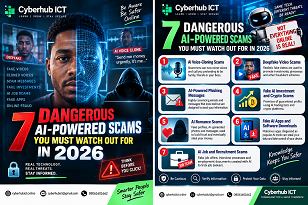
Here are seven dangerous AI-powered scams you should watch out for in 2026.
1. AI Voice-Cloning Scams
Imagine receiving a phone call from your son, daughter, spouse, friend or boss.
The voice sounds exactly like them.
They tell you:
“I’m in trouble. Please send me money quickly.”
The frightening part is that the voice may not actually belong to that person.
Artificial intelligence can now reproduce someone’s voice from recordings found in videos, social media posts, voice notes or other publicly available content.
Scammers can use these cloned voices to create fake emergency situations.
They may claim that someone:
- Has been arrested
- Was involved in an accident
- Needs urgent hospital treatment
- Lost their phone
- Needs emergency financial assistance
How to protect yourself
Never send money simply because you recognize a person’s voice.
Hang up and call the person using a phone number you already know.
Families can also create a private emergency word or question that only trusted family members know.
If someone claiming to be your relative cannot provide the agreed information, treat the call as suspicious.
2. Deepfake Video Scams
AI can now create realistic videos that appear to show real people saying things they never actually said.
This technology is known as a deepfake.
Scammers can create fake videos of:
- Celebrities
- Business executives
- Religious leaders
- Government officials
- Popular influencers
- Friends and relatives
The fake person may appear to recommend an investment opportunity, cryptocurrency platform, giveaway or business scheme.
The FBI reported in April 2026 that scammers were using believable videos depicting public figures and loved ones as part of AI-related fraud. (FBI)
Example
You may see a video showing a famous person saying:
“I invested ₦50,000 on this platform and earned ₦500,000 within 24 hours.”
The video might look convincing, but the person’s face and voice could have been generated or manipulated with AI.
How to protect yourself
Do not invest money because of a social media video alone.
Check:
- The person’s official social media accounts
- The company’s official website
- Independent news reports
- Whether the investment company is properly registered
- Whether unrealistic profits are being promised
Remember:
A familiar face does not automatically make an online investment genuine.
3. AI-Powered Phishing Messages
Phishing is one of the oldest internet scams, but artificial intelligence is making it more dangerous.
Previously, many phishing messages contained poor grammar, spelling mistakes and strange sentences.
Today, AI can generate highly professional messages that look as though they came from:
- Banks
- Microsoft
- Employers
- Government agencies
- Schools
- Delivery companies
Microsoft reported in 2026 that AI is helping attackers create more personalized and convincing phishing messages. Its security researchers said AI-assisted phishing campaigns can be significantly more effective than traditional approaches. (Microsoft)
Example
You receive an email saying:
“We detected suspicious activity on your account. Your account will be suspended within 24 hours unless you verify your identity.”
A button underneath says:
VERIFY ACCOUNT
The website may look exactly like the real company’s website.
But when you enter your password, the information goes directly to the attacker.
How to protect yourself
Avoid logging into important accounts through links sent by unexpected emails or messages.
Instead, open your browser or official app and visit the service directly.
Also enable:
- Two-factor authentication
- Passkeys where available
- Login alerts
- Strong, unique password
4. Fake AI Investment and Cryptocurrency Scams
Investment scams have become one of the most financially damaging forms of online fraud.
Scammers increasingly use terms such as:
AI trading bot
Automated crypto investment
AI forex trading system
Guaranteed AI profit
AI-powered investment platform
These words can make fraudulent schemes sound technologically advanced and trustworthy.
The FBI’s 2025 Internet Crime Report, released in 2026, recorded more than $11 billion in reported cryptocurrency-related losses in the United States alone. Investment fraud was also a major driver of cyber-enabled fraud losses. These figures relate to U.S. reports, but they illustrate the financial scale of this type of crime. (FBI)
Common warning signs
Be suspicious if a platform promises:
- Guaranteed daily returns
- No possibility of losing money
- Extremely high profits within hours
- Bonuses for recruiting other members
- Withdrawals that require repeated additional payments
- A mysterious “AI robot” that supposedly never loses
AI technology cannot remove financial-market risk.
Any investment platform claiming guaranteed profits should be treated cautiously.
5. AI Romance Scams
Romance scams have existed for many years, but generative AI gives scammers powerful new tools.
A criminal can now create:
- Realistic profile photographs
- Romantic messages
- Long conversations
- Fake voice messages
- Artificial video clips
- Entire social media identities
The person you have been chatting with for several months may not exist at all.
AI allows criminals to communicate with many victims simultaneously while making each conversation appear personal.
The scam usually develops gradually
The scammer first builds trust.
Later, they may claim to need money for:
- Medical treatment
- Travel expenses
- Visa processing
- Business problems
- Customs clearance
- Emergency situations
Some eventually introduce victims to fake investment or cryptocurrency websites.
How to protect yourself
Be cautious when someone you have never met begins asking for money.
Consider conducting a reverse-image search on their photographs.
Ask for spontaneous video conversations rather than relying solely on photographs or prerecorded clips.
And remember:
Love should not require repeated emergency bank transfers to someone you have never met.
6. Fake AI Apps and Software Downloads
People are eager to try new AI applications.
Cybercriminals know this.
They may create websites advertising:
- Free premium ChatGPT
- Unreleased AI tools
- AI image generators
- AI video software
- AI trading software
- Free AI plugins
- Cracked premium AI applications
The software may secretly contain malware.
Microsoft reported in September 2026 that attackers had already been using well-known AI brands as bait. Researchers observed fake ChatGPT-related phishing, fraudulent AI installers and malicious advertisements promoting fake AI software. (Microsoft)
One malicious program could potentially steal:
- Browser passwords
- Email credentials
- Cryptocurrency wallet information
- Banking information
- Personal files
- Authentication tokens
How to protect yourself
Download software only from official websites and trusted app stores.
Never disable antivirus protection simply because a random website tells you it is required for installation.
Also be cautious with cracked or modified applications.
A “free premium AI tool” could become extremely expensive if it steals your financial information.
7. AI Job and Recruitment Scams
With many people searching for remote jobs and online income opportunities, fake recruitment scams have become particularly attractive to criminals.
AI allows scammers to create highly convincing:
- Job advertisements
- Company websites
- Interview questions
- Recruitment emails
- Offer letters
- HR profiles
- Fake company representatives
The scammer might advertise positions such as:
Remote Data Entry Officer – $2,000 Monthly
AI Content Assistant
Virtual Assistant
Customer Support Representative
Remote Software Developer
After interviewing you, they may request money for:
- Registration
- Training
- Equipment
- Background checks
- Processing
- Work permits
Others may send fake payment cheques or request your banking login information.
How to protect yourself
Before accepting a job opportunity:
Check the company’s official website.
Search for the recruiter’s name on LinkedIn.
Confirm that the recruiter’s email comes from the company’s genuine domain.
Never surrender your passwords or OTPs.
Be extremely careful when an employer demands money before you can start working.
A legitimate recruitment process should not require you to pay a stranger simply to receive your salary.
Why AI Scams Are Becoming More Dangerous
The biggest problem with AI scams is not necessarily that criminals have invented completely new crimes.
Instead, artificial intelligence allows them to make old scams more believable and scalable.
Microsoft’s 2026 Responsible AI report says AI misuse is increasingly exposing people to scams, fraud and cyber exploitation. (Microsoft)
AI can help criminals quickly:
- Write convincing messages
- Translate scams into multiple languages
- Personalize phishing emails
- Produce realistic photographs
- Clone voices
- Create fake identities
- Develop fraudulent websites
- Generate fake videos
- Automate conversations
This means the old advice of simply looking for grammatical errors is no longer enough.
The Most Important Rule: Slow Down
One thing almost every scammer wants you to do is act quickly.
They might say:
“Pay within the next 10 minutes.”
“Your account will be permanently blocked.”
“Don’t tell anyone.”
“This opportunity ends tonight.”
“Your son needs money immediately.”
“Confirm this OTP now.”
The FBI specifically advises people to resist pressure to act quickly when confronted with potential scams. (FBI)
Whenever someone creates unnecessary urgency, slow down.
Verify the information independently.
A few minutes of verification could save you from losing money or your online accounts.
How to Protect Yourself From AI Scams
You don’t need to become an artificial-intelligence expert.
Develop strong digital habits.
Always verify unusual requests
If someone asks for money, passwords, OTPs or sensitive information, confirm their identity through another communication method.
Enable two-factor authentication
Use two-factor authentication or passkeys on important accounts.
Never share OTPs
Your one-time password is meant for you.
Do not give it to anyone who contacts you by phone, WhatsApp, SMS or email.
Use different passwords
Avoid using one password for Facebook, Gmail, WhatsApp, banking services and other accounts.
A password manager can help you create and store unique passwords.
Be careful with QR codes
Fraudulent QR codes can direct you to malicious websites or link devices to accounts.
WhatsApp introduced additional device-linking warnings in 2026 because scammers have been attempting to trick users into linking victims’ WhatsApp accounts to criminal-controlled devices. (Facebook)
Don’t trust everything you see or hear
A video can be fake.
A photograph can be AI-generated.
A voice can be cloned.
A professional-looking email can come from a scammer.
A website can imitate a legitimate company.
Verification is now more important than appearance.
What Should You Do If You Have Already Been Scammed?
Act immediately.
Contact your bank or financial institution if money was transferred.
Change passwords for affected accounts.
Log out unknown devices.
Enable stronger authentication.
Inform friends and relatives if your social media or messaging account has been compromised.
Report fraudulent social media accounts to the relevant platform.
Keep screenshots, phone numbers, email addresses, payment receipts and transaction details as evidence.
If financial fraud is involved, report the matter promptly to the appropriate financial institution and law-enforcement authorities in your country.
Final Cyberhub ICT AI Scam Checklist
Before sending money or providing personal information online, ask yourself:
Do I personally know this person?
Have I verified this information independently?
Is someone pressuring me to act immediately?
Am I being promised unrealistic profits?
Has someone asked for my password, OTP or verification code?
Did I independently confirm that this website is genuine?
Could this voice, photograph or video have been generated using AI?
If something does not feel right, investigate before taking action.
Conclusion
Artificial intelligence is one of the most powerful technological developments of our time.
But powerful technology can be used for both good and bad purposes.
As AI-generated voices, photographs, messages and videos become increasingly realistic, internet users must develop stronger cybersecurity awareness.
The goal is not to become afraid of AI.
The goal is to become more difficult to deceive.
Remember:
Pause before you pay.
Verify before you trust.
Think before you click.
And never assume that something is genuine simply because it looks or sounds real.
About Cyberhub ICT
Cyberhub ICT Center provides practical ICT training and technology services including Internet & Cyber Security, Web Design & Blogging, Digital Marketing, Desktop Publishing, Graphics Design, Social Media Management and Content Creation.
For more practical technology tutorials, cybersecurity awareness and digital-skills guides, follow Cyberhub ICT.
Website: cyberhubict.online
Email: cyberhubict@gmail.com
Phone: 08061601662
Frequently Asked Questions
What is an AI scam?
An AI scam is a fraudulent scheme that uses artificial intelligence to make deception more convincing or easier to scale. This may include AI-generated messages, cloned voices, deepfake videos, fake identities or automated phishing attacks.
Can scammers clone someone’s voice?
Yes. AI voice-generation systems can imitate voices from recorded samples. That is why recognizing a person’s voice alone should not be considered proof of identity.
Can AI create fake videos of real people?
Yes. Deepfake technology can manipulate or generate video and audio to make it appear that someone said or did something they did not actually say or do.
How do I know whether an AI investment platform is genuine?
Check its registration, ownership, regulatory status, independent reviews and withdrawal conditions. Be particularly suspicious of guaranteed returns and claims that an AI system cannot lose money.
Can AI-generated phishing emails look professional?
Yes. Modern generative AI can create polished, grammatically correct and highly personalized phishing messages. (Microsoft)
What is the safest thing to do when I suspect a scam?
Do not send money or disclose sensitive information. Stop the conversation and independently verify the identity of the person or organization.
